Sunday, September 08, 2019

M(alpha)NP Acid: An Alternative To Separate Alcohol Enantiomers

How do you usually handle alcohol racemic? Do you separate the enantiomers? How to do it? Column Chromatograph? 

Sometimes, using column chromatograph equipped with a chiral column can be helpful in separating the enantiomers. However, sometimes it doesn't work. Introducing M(alpha)NP Acid is one of the alternatives to separate the alcohol enantiomers. This method was developed by Kasai et al (2004). This powerful chiral molecular tool is able to determine their absolute configurations in an unambiguous way through 1H NMR anisotropy Method.  


How to introduce the M(alpha)NP Acid into the molecule? Here is the way:

The racemic of alcohol compound is added with 1,4-dimethylaminopyridine (DMAP), 10-camphorsulfonic acid (CSA), and 1,3-dicyclohexylcarbodiimide (DCC), then dissolved them with dichloromethane (DCM). Stir them at room temperature overnight. After working up the reaction solution, try to purify with column chromatograph, then measure the 1HNMR of first and second eluted sample because we need the chemical shift data from both to do the calculation through 1HNMR anisotrophy method. 

To know whether the 1st eluted sample is  S or R configuration, firstly, assign the proton from the NMR spectrum. Put the chemical shift data like the picture below. Left side for the 1st eluted sample and the right side for the 2nd eluted sample. Then, subtract the value of chemical shift data of 2nd eluted sample with 1st eluted sample. Then put the result on each proton location in the structure and always arrange it based on the sector rule. 
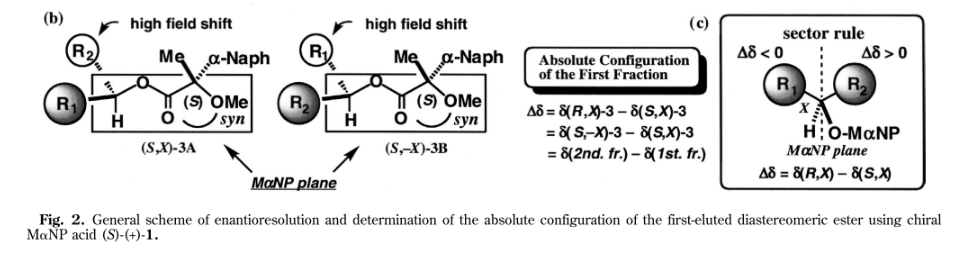

The M(alpha)NP Acid with thick black arrow, H proton with a dashed arrow, and left side for the proton which the result of the subtraction less than 0 (negative), and right side for proton which the result of the subtratction more than 0 (positive). By arranging like that, now we can see the configuration of the 1st eluted sample. The direction is counterclockwise, so the 1st eluted sample is S-configuration. This determination also means that the 2nd sample is in the opposite configuration which is R-configuration.


All the data and explanation is referred to this reference:
Kasai, Y., Ji, H. T. A., Fujita, T., Yamamoto, Y., Akagi, M., Sugio, A., … Harada, N. (2004). M A NP Acid , a Powerful Chiral Molecular Tool for Preparation of Enantiopure Alcohols by Resolution and Determination of Their Absolute Configurations by the 1 H NMR Anisotropy Method, 585(10045022), 569–585. https://doi.org/10.1002/chir.20077

XtalFluor-E: Selective Fluorination Reagent


XtalFluor-E (diethylamino difluorosulfunium tetrafluoroborate) appears as one of deoxyfluorinating reagents that improve the weakness of DAST. Different from DAST which is liquid reagents, XtalFluor-E is a solid reagent so it's more stable. 

The mechanism of deoxyfluorination with XtalFluor-E is similar to DAST. The reaction also involves the dialkylaminodifluorosulfane intermediate. However, the difference is, when using XtalFluor-E, it release tetrafluoroboric acid and the reaction also fluoride starved so the side reactions often occur such as the formation of ether compound. For example, see the scheme below. 


Therefore, the reaction with XtalFluor-E usually involves additive such as Et3N.3HF (triethylamine trihydrofluoride) as the source of exogenous fluoride (see the table below). However, the order of the addition of Et3N.3HF should be noted. The yield will be better if the addition of this additive is done with the reagent (XtalFluor-E) before the addition of the substrate. If it is done after the addition of substrate and reagent, then the yield will not be improved because the deoxyfluorination has occurred instantaneously already. That's why the addition of Et3N.3HF after that will be less meaning.   


The addition of strong base might be improving the yield as it will work for the deprotonation. The work from previous table shown also explained that the addition of DBU as non-nucleophile strong base improved the yield of the reaction and reducing the side reactions. Although the yield was improved, the reaction rates were slower than when using Et3N.3HF.

All the data and explanation is refered to this reference:
Heureux, A. L., Beaulieu, F., Bennett, C., Bill, D. R., Clayton, S., Mirmehrabi, M., … Couturier, M. (2010). Aminodifluorosulfinium Salts : Selective Fluorination Reagents with Enhanced Thermal Stability and Ease of Handling †,‡, 3401–3411. https://doi.org/10.1021/jo100504x

DAST: The First Deoxyfluorination Reagent


Reported by a chemist at Dupont in 1975, DAST (Dietylaminosulfur trifluoride) became a stable to gaseous SF4 (Wen-Li Hua, Xiang-Go Hu, & Hunter, 2017) . This gaseous reagent, SF4, is extremely toxic and corrosive. Hence, DAST appeared as an alternative in liquid form. The excellence of DAST than SF4, DAST is easier to be handled as it doesn't require much higher temperatures.

Nevertheless, it was soon found that DAST also has some weaknesses. If it undergoes heating, it can decompose and produce SF4 as we already knew that this substance is toxic and corrosive. If it undergoes further heating, it can explode into undefined gases and black char (Heureux, et al., 2010). 

Then, Deoxofluor was developed. From differential scanning calorimetry (DSC), Deoxofluor has the same decomposition temperature with DAST, yet it degrades slower so it is considered safe.

Do you know? Soon after DAST and Deoxofluor conducted in larger scale, it is found to be unsafe. The preparation process was problematic. First, the purification of the crude using vacuum distillation is dangerous as they are explosive. Secondly, after the manufacturing, the shipping regulation is very strict. Thirdly, these reagent is also not stable in color. Fourthly, during the use, both may generate free HF which is very volatile, highly toxic, extremely corrosive to the skin and other tissues including bones (Heureux, et al., 2010).

Nonetheless,  DAST remains the most popular deoxyfluorination reagent because of its availability and general scope (Nielsen, Ugaz, Li & Doyle, 2015). Deoxyfluorination is a reaction of introducing fluorine atom into a molecule through the substitution of alcohol functional group. The reaction with DAST proceeds with inversion. It goes with SN2 reaction as the alcohol functional group is a poor leaving group, the alcohol then is converted into weaker base by being attached with the electrophilic sulfur atom. Then, the nucleophile, the fluorine atom with negative charge, attacks from the backside of the carbon atom which is the electrophile. It attacks from the backside since the leaving group which is attached with the electrophile blocks the approach of the nucleophile from the frontside. That's why it simply goes with inversion through SN2 reaction.


In deoxyfluorination, DAST also has limitation. It may produce side products. If the substrate has double bond, it may undergo elimination. And if the substrate has carbonyl group, it may be difluorinated. Therefore, several new reagents has been developed to improve the selectivity.  


Reference:
Heureux, A. L., Beaulieu, F., Bennett, C., Bill, D. R., Clayton, S., Mirmehrabi, M., … Couturier, M. (2010). Aminodifluorosulfinium Salts : Selective Fluorination Reagents with Enhanced Thermal Stability and Ease of Handling †,‡, 3401–3411. https://doi.org/10.1021/jo100504x
Nielsen, M. K., Ugaz, C. R., Li, W., & Doyle, A. G. (2015). PyFluor: A Low-Cost, Stable, and Selective Deoxy fl uorination Reagent, 9571–9574. https://doi.org/10.1021/jacs.5b06307
Wen-Li Hua, Xiang-Guo Hu, L. H. (2017). Recent Developments in the Deoxyfluorination of Alcohols and Phenols : New Reagents , Mechanistic Insights , and Applications, 4917–4930. https://doi.org/10.1055/s-0036-1590881